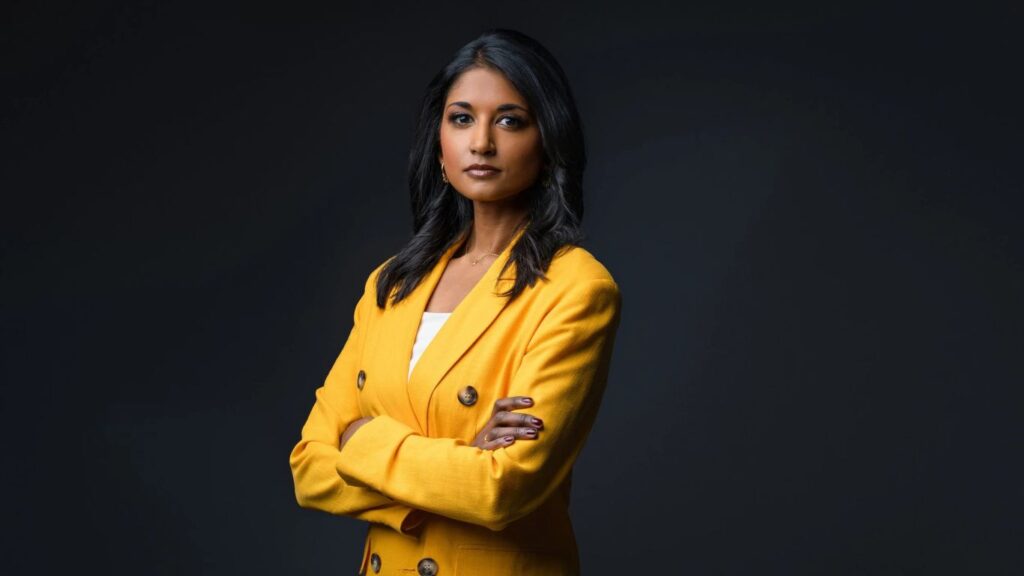
Sumi Somaskanda has spent her career in the gap between countries, languages and political systems. For many she is a familiar face on BBC News, anchored from Washington D.C. with a calm delivery that fits elections, wars, diplomatic crises and breaking news. But her career did not start on the world stage, nor did it follow the path of a television celebrity seeking notoriety. It grew by reporting, writing, producing, editing and years of explaining European and American politics to far-flung audiences beyond one country.
That is what is interesting about the Somaskanda. She is not one of those star journalists whose private life is their public profile. She’s a working international broadcaster, and her name has become more widely searched as the BBC has grown its U.S. news operation and put her in front of major global stories. Sumi Somaskanda history: BBC Anchor and Journalist Her history is best read via the work itself: the newsrooms, the beats, the languages, the subjects she returned to, the professional reputation that took her from Berlin to Washington.
Who Is Sumi Somaskanda?
Sumi Somaskanda is an American journalist, BBC News chief presenter, anchor, writer, editor and moderator. She is based in Washington DC presenting international news for the BBC and part of the broadcaster’s extended coverage of US politics. She had worked for Deutsche Welle, Germany’s international broadcaster, for many years in Berlin before joining the BBC. Her career has been in print, TV, radio, podcasting, public speaking and live event moderation.
Somaskanda is known for her work in international news, not one viral interview, or a headline-grabbing moment. Her public record is that of a journalist covering politics, immigration, economy, cyber security, disinformation, democracy and transatlantic affairs. The range counts, because she’s often done work on subjects that demand background, not immediate reaction. She is known for explaining complex political developments in a way that makes them accessible without losing their seriousness.
For many searchers the initial query is simple: why is she on BBC News, and where did she come from? The solution begins in the United States, moves through local and regional journalism, deepens in Berlin and comes back to Washington via one of the world’s best-known news organisations. Somaskanda’s career is a reminder that accomplished anchoring is typically the final apparent layer of a much longer professional existence. Behind the desk is a reporter who has spent years trying to figure out how institutions, voters, governments and public trust change under pressure.
Family Background and Early Life
There is little reliable public information about Sumi Somaskanda’s early family life. Her private background is not a large part of her public image and professional profiles concentrate on education, languages, reporting and broadcast work. That makes it hard to say anything conclusive about her parents, her siblings, her childhood home, or early familial influences, with the certainty that a respectable biography requires. One may say that her public profession indicates a very worldwide outlook and a comfort with moving between cultures.
The language background of Somaskanda provides one of the clearer windows into that larger outlook. Her public professional profiles say she is a native English speaker who is fluent in German and Spanish and conversational in Tamil. Some profiles refer to the Tamil as Sri Lankan Tamil, but she has not built her public identity based on family biography or personal origin stories. Language may be a determinant of access, listening and confidence in journalism. Her multilingualism helps make sense of the breadth of her work.
Her biography also suggests an American foundation. She worked for the U.S. media, spent a long time in Germany and then came back to Washington as a BBC anchor. The move hints at a professional life forged by American journalistic training and European political experience. It also explains how she can speak to global audiences about U.S. politics without making America seem like a closed domestic subject.
The First Steps in Journalism and Education
Somaskanda had extensive training in journalism, including at the Medill School of Journalism at Northwestern University, one of the most prestigious journalistic schools in the United States. Her career path is an example of the pragmatic reporting, straight writing and discipline in the newsroom traditionally associated with Medill. She didn’t go straight into a senior international presenting post. Like many professional broadcast journalists, she developed her skills in many media before becoming a high-profile anchor.
Her earliest professional credits show that she worked on local and regional television and radio in the United States. Those early years seemed to encompass reporting, producing, anchoring and documentary work. Global broadcasting may have more cachet, but local journalism teaches speed, accuracy, impartiality and the discipline of breaking down the news for individuals who don’t follow politics all that closely. Those habits are hard to fake later in your career.
Before developing her image as an international correspondent and presenter, she worked as a producer. Producing is often invisible to viewers, but it is one of the strongest foundations that a journalist can have. A producer learns how stories are selected, how scripts are assembled, how facts are verified under time pressure, and how live programming is held together. The training behind the scenes probably accounts for Somaskanda’s later ease across broadcast platforms.
Building a Career Across Formats
One of the hallmarks of Somaskanda’s career is that she has never been just one kind of journalist. Her career includes work as a reporter, anchor, writer, editor, producer, podcast host and moderator. That’s not uncommon in modern media but in her case the different parts seem to have fed each other rather than pulling her in different directions. She developed her editorial judgement by producing, honed her analysis through writing, and became a public guide through fast-moving tales through anchoring.
Her bylines have been featured in prominent worldwide magazines and broadcasters, including those that are noted for their coverage of foreign policy, politics and global affairs. Her writings have addressed German politics, debates around immigration, the far right, cyber risks, economic divisions, refugee policy and public mistrust of the media. These are not light themes, and they require reporting that can connect human tales to institutions and history. Somaskanda’s written record suggests a journalist attracted to the moments when democracy and social transformation become hard to govern.
And that breadth worked to her advantage on television. International anchor must be more than a steady hand and a clear voice. She has to be able to comprehend why a story important, where it fits in a wider arc, which elements are most relevant, and what the viewer needs first. That broader editorial base was gained through Somaskanda’s journey through many forms of journalism.
The Deutsche Welle Chapter and the Berlin Years
Berlin was the main proving ground for Somaskanda’s worldwide career. She was in the German capital for about 14 years, reporting and presenting shows during a time when Germany was at the centre of some of the most important political discussions in Europe. These years brought the Euro crisis, the refugee crisis, the growth of the Alternative for Germany, tensions with Russia, worries about digital security and renewed discussions over Germany’s place in the world. Berlin was a journalist’s fantasy, a front-row seat for national and global stories.
Somaskanda was a senior correspondent and presenter for DW News at Deutsche Welle. DW is the worldwide broadcaster of Germany. Its English-language service reaches a global audience well beyond Germany. The coverage is not just objective but also engaging and thought-provoking. That made her work different from German broadcasting at home. She wasn’t just describing German or European trends to local audiences; she was interpreting them for a worldwide audience that needed context, clarity and perspective.
Her DW years also provided her with regular practice in breaking news and live worldwide coverage. International news needs to be handled carefully, because often reports are fragmentary, emotionally charged and have ramifications that cross borders. An anchor must avoid false certainty but still give viewers a clear account of what’s known. That experience was directly built upon in Somaskanda’s eventual BBC post.
Covering Germany, Migration and Democracy
Somaskanda’s written reports from Europe show a consistent interest in democratic pressure points. She wrote on the refugee crisis in Germany, the politics of asylum, fears about extremism, public broadcasting under attack, economic resentment in eastern Germany and the appeal of the far right in places where voters felt ignored. These themes required caution since they were easy to flatten into stereotypes. Her best work blended political, social and human stories.
One of the big European stories of her Berlin years was the refugee crisis: Germany’s choice to open its doors to significant numbers of asylum seekers changed internal politics, challenged institutions and became a defining issue for Chancellor Angela Merkel’s government. For the worldwide reader, the story cannot be told by figures or slogans alone. It meant seeing schools and housing, local officials, anxieties about security, integration and the political movements that rose in reaction.
Somaskanda also reported on the rise of Germany’s far right and the widening gap between eastern and western Germany. These stories were essential, not least because they highlighted how history can be inside modern politics. Economic disillusionment, cultural grievance, anxieties about migration and suspicion of elites were linked. Somaskanda created a reporting beat around those themes that would eventually make her especially relevant to coverage of American politics, where many of the same worries have moulded elections and public life.
Writing, Editing & Public Voice
Somaskanda has an unusually strong career for a TV presenter due to her substantial public writing record. Her writing has been featured in The Atlantic, Foreign Policy, The Washington Post, Al Jazeera, Newsweek, USA Today, PRI, GlobalPost and others. These bylines tell us she was reading news for viewers and writing and moulding stories for readers. That’s important because written journalism leaves a trail of editorial decisions that can be judged over time.
Her writing generally resides at the nexus of politics and public trust. She has reported on disinformation, cyber threats, media scepticism and political polarisation. These have become core issues for journalism itself, not just as subjects but as pressures on the profession. A journalist who has spent years reporting information disorder is better placed to understand why audiences could be sceptical, confused or overwhelmed.
She was also an editor at Berlin Policy Journal and a host of Studio Berlin, a current affairs podcast. Her profile grew beyond daily reporting through those responsibilities. Editing is about judgement of structure, evidence, and voice. Podcast hosting is about discourse, rhythm, and authority on the subject. Together they helped mould Somaskanda into a journalist who could move between forms, while retaining the core mission of explaining current affairs.
Change to BBC News
In 2023 Somaskanda became a lead presenter at BBC News, a big breakthrough in a worldwide career that was already underway. It is part of a bigger expansion of the BBC’s U.S. news teams, and she will be stationed in Washington DC. Her appointment came when the BBC was moving more towards North American coverage and developing programmes from Washington. The timing put her at the center of one of the world’s most closely followed political sagas: the United States hurtling into another high-stakes presidential election.
The move made sense, given her history. Somaskanda brought years of experience as a European reporter, anchoring global news and understanding of the democratic strains that have affected both Europe and the United States. U.S. politics is not a domestic story for BBC audiences, especially outside America. It touches wars, alliances, climate policy, migration, trade and global institutions.
The role of Somaskanda as a chief presenter is visible and responsible. The anchor is the face that viewers see, but the work requires editorial judgement, interview preparation, real-time coordination, and the ability to guide audiences through uncertainty. The BBC brand can open doors but it brings scrutiny too. In that atmosphere, the calm, well-informed manner of Somaskanda suits the needs of worldwide broadcasting.
U.S. World News America Washington Coverage of Election
BBC coverage of U.S. politics made Somaskanda’s presence in Washington more obvious. She’s worked on World News America, the BBC’s Washington-based show that aims to explain developments in the US to audiences throughout the world. Somaskanda was one of the anchors and reporters across platforms for the BBC’s enhanced U.S. election programming for the 2024 election cycle. That work placed her in the middle of a story closely watched in Europe, Asia, the Middle East and elsewhere.
She was also tasked with reporting on voters in battleground states for election work. Such reporting is essential because it goes beyond polling averages and campaign speeches to ask what voters really think about the economy, immigration, democracy, foreign policy and leadership. Somaskanda’s background was perfectly suited to those chats. She had already spent years trying to bridge the gap between institutional politics and public frustration in Europe.
She also presented BBC audio material that explores America’s relationship with the world. The endeavour is a reflection of the broader objective of her Washington post. For worldwide audiences, the question is not just who wins an election, but what American decisions mean for Ukraine, the Middle East, climate agreements, NATO, China policy, migration, and trade. Somaskanda’s profession has equipped her to make such connections evident without boiling them down to easy answers.
Public image, on-air personality
Somaskanda cultivates a professional, calculated and serious public persona. She doesn’t seem to want attention through personal disclosure, social-media theatrics or opinion-heavy branding. She is persuasive because she is clear, calm, fluent in her subject. She is of the older tradition of the anchor as guide, not performer, in a media society that often rewards fire.
That is not to say that her work is cold. The anchors viewers identify with are those who are able to be serious without sounding distant. Somaskanda’s style tends to fall in that bracket. She is frank, but not rude. She can cover political turmoil, war, social unrest and keep the audience orientated. That’s a harder skill than it looks, especially when live news happens faster than established fact.
Her public face also takes from the tradition of worldwide broadcasting of the BBC and DW. These institutions require speakers to speak to audiences with different assumptions, political cultures, and degrees of background knowledge. An anchor in that position can’t count too much on a local shorthand. Somaskanda’s manner is suited to this need, as she usually makes stories accessible while keeping their stakes intact.
Marriage, Children and Family Life
Sumi Somaskanda has kept her personal life under wraps. There is no clear confirmation from reliable public sources that she is married, has children or has close family links. Some internet biography pages claim to know better, although these statements tend to be poorly referenced or repeated without evidence. Responsible profile should not turn ambiguity to speculation.
Such privacy is typical among journalists covering politics and foreign events. News anchors, unlike actors, influencers or entertainment icons, are public because of their employment, not their personal life. Keeping a boundary can also safeguard both the journalist and those around them. In the instance of Somaskanda, the accessible public record is weighted heavily towards her career rather than her family life.
Television offers a sense of familiarity so readers may still look for those things. Viewers can get curious about the person who plays the character with regular appearances on screen. But curiosity does not yield verified information. The best answer is that Somaskanda’s family life is not documented in reliable detail, publicly, and she seems to have chosen to keep it that way.
Income Source and Net Worth
No credible public figure of Sumi Somaskanda net worth is available. Some sites will post estimates, but these numbers are often speculative and should not be taken as truth. Journalists’ salaries vary widely by job title, employer, country, contract, seniority and outside work. Individual compensation details are not public in most cases. In the absence of verifiable financials, any specific number would be a guess.
Her sources of income are more readily described in broad terms. Somaskanda’s experience includes all forms of broadcast journalism, writing, editing, podcast hosting, moderation, speaking and teaching. The main current income of a BBC chief presenter would be reasonably linked to her broadcast function, but individual remuneration details are secret. Any other paid moderating or event labour would be up to her arrangements and workplace guidelines.
Net worth searches are a staple of prominent people, yet they are generally among the least credible sections of biography culture online. For Somaskanda, the financial aspect that matters more than a figure is the level of professional standing her jobs indicate. A transition from DW senior presenter to BBC chief presenter is a step up the media ladder. It does not, by itself, indicate personal riches.
Professional Standing, Honours & Awards
The reputation of Somaskanda rests not on a long list of widely advertised awards, but on reputable appointments and engagement in serious public forums. She has served as a speaker or moderator at important policy and civic events, including forums on truth, trust, misinformation, trade, migration, and international affairs. These invitations are a sign of professional competence. They also demonstrate that her work is known beyond the studio.
Her appointment as a BBC chief presenter is itself a major career marker. The BBC is one of the most scrutinised news organisations in the world – and the best presenting jobs are highly visible. They are not appointed solely for on-camera presence. They demand editorial credibility, live-news experience and the ability to represent the organization on major stories.
Her previous employment as DW’s senior presenter further demonstrates her stature in international media. DW and the BBC both work for an international audience and need journalists who can handle different countries, accents, political assumptions and background knowledge. Somaskanda’s stint at both organisations put her in a small club of broadcasters with extensive experience on both sides of the Atlantic.
Controversies and Public Outcry
There are no significant, publicly-reported personal controversies linked with Sumi Somaskanda in the credible public record. That is not to say, however, that she has not experienced professional criticism, for public broadcasters and political journalists work in closely watched contexts. Doesn’t mean there’s no major scandal or controversy to her bio. Doesn’t mean there’s no major public scandal. Her public record is labour, not personal soap opera.
But the topics she discusses can be divisive. It’s understandable that U.S. elections, migration, far-right parties, war, trust in the media and misinformation all trigger strong responses from the public. Journalists who cover those topics are often also the target of criticism from viewers who detest the framing, the questions, or the institution. That’s part of modern political journalism, especially for the worldwide broadcasters.
What is interesting is the consistent public face of Somaskanda. Her brand isn’t founded on provocation or ideological performance. Her work is of a kind of journalism in which credibility is based on restraint and preparation and on the rigorous distinction between verifiable fact and assertion. It could seem nearly old-fashioned in today’s media environment but it is also why audiences flock to professional broadcasters in big events.
Where Sumi Somaskanda Is Now
Sumi Somaskanda is today best known as a BBC News chief presenter based in Washington, D.C. Her work puts her close to the heart of U.S. political coverage for a global audience. She remains a fixture on BBC programs explaining American politics, foreign relations and important breaking topics. Why her base in Washington matters is that so much of the world’s political attention flows through the U.S. capital.
Today her standing is also part of a larger shift in news. International broadcasters need anchors who can work across TV, digital video, podcasts, social media, live events and field reporting. Somaskanda’s career has already traversed those formats. And that makes her a logical fit for a BBC organization striving to attract viewers who no longer consume news in one fixed way.
In fact, her biography is being written in real time. She has transitioned from honing skills in Berlin to applying that experience in Washington at a tumultuous time in American and world affairs. The same issues that have marked the first part of her career – democracy, trust, migration, power, and the difficulty of expressing complicated events in simple terms – will probably mark the next phase.
FAQ Frequently asked questions
Sumi Somaskanda is the Co-Founder & CEO of Qwiklabs, an interactive learning platform for software developers and IT professionals. Prior to founding Qwiklabs, Sumi co-founded and was the COO of Cloud Sherpas, an AWS-focused professional services firm. Sumi also serves on the Board of Directors for the Colorado Technology Association.
Sumi Somaskanda is an American journalist and BBC News chief presenter based in Washington D.C. She is known for presenting international news and for earlier work as a senior presenter and correspondent at Deutsche Welle in Berlin. She has also written, edited, hosted a podcast, taught, and moderated public policy events.
She has reported on politics, immigration, economy, disinformation, cyber security and international affairs. Her profile has risen with the BBC’s expansion of its US coverage and its use of Washington-based presenters to explain American politics to international audiences. More acknowledged as a serious worldwide journalist and less as a celebrity figure.
Sumi Somaskanda’s nationality is Sri Lankan.
Sumi Somaskanda is typically described as American journalist in professional profiles. But her career has been quite international. She has worked in Germany for many years, speaks multiple languages and has covered European and American politics for global audiences.
Her American heritage is particularly pertinent to her current BBC work in Washington. She is well versed in US politics and long experienced in explaining European affairs. That blend lends her work a transatlantic quality that suits the BBC’s global audience.
Before BBC News, where did Sumi Somaskanda work?
Somaskanda, before joining BBC News, worked for Deutsche Welle, the international broadcaster from Germany. She is a former senior presenter and correspondent for DW News, and was based in Berlin for many years. During that time she reported on major European and global stories, including German politics, migration, democracy and international crises.
She also worked in radio, television, print and podcasts, and wrote for many prestigious magazines. She began her career with experience in U.S. local and regional media and production. While her broad base helped prepare her for major international broadcast responsibilities.
Sumi Somaskanda is wedded.
Sumi Somaskanda has not made any public confirmations regarding her marital status in any credible sources. Some websites claim to know if she is married, however many of these assertions are not backed up by solid evidence. For that reason, her relationship status should be treated as private unless she decides to share it directly.
This privacy aligns with her public persona. Somaskanda has maintained the focus on journalism, not personal publicity. Her public bio highlights her work, languages, reporting and worldwide media positions.
Does Sumi Somaskanda have kids?
We have no solid public confirmation that Sumi Somaskanda has children. Her professional biography and large public profiles don’t tell much about her family life. Any assertions about children should be taken with a grain of salt unless it’s from a reliable source like Somaskanda herself.
Many viewers get curious about anchors they see on TV frequently, but not all personal details are public record. Somaskanda seemed to keep a sharp division between her work and her personal life. “Respect that line.
What is the net worth of Sumi Somaskanda?
Sumi Somaskanda’s verified net worth is not available. Online estimates, if they exist, should be regarded as guesswork, as they typically do not cite any solid financial information. Journalists’ personal finances are not typically public and exact salary details are usually private.
Her likely known income streams would be as a senior broadcast journalist and possible income from writing, moderating, speaking or teaching at various stages in her career. But there’s no responsible way to say how many. More to the point, she is a prominent figure at one of the world’s premier news organisations.
Sumi Somaskanda Languages Which Languages Sumi Somaskanda Speaks?
Public professional profiles list Sumi Somaskanda as a native English speaker, also fluent in German and Spanish. She is also reported to be able to speak conversational Tamil. She put those language skills to good use in a career that took her across the United States and to Germany and international news.
Language ability is important in journalism because it influences access, listening and cultural understanding. Somaskanda’s multilingual background may have added to her reporting in Europe and allowed her to transition easily between international audiences. That is one of the reasons her career is of such a markedly international character.
Summary
Sumi Somaskanda’s story is not a spectacle-driven celebrity biography. It’s the biography of a journalist who won visibility via consistent work across countries, forms and challenging issues. She climbed from early media jobs to Berlin reporting, from DW News to the BBC, from European politics to Washington’s world stage. Each step added to the air of authority viewers see today.
Her career is marked by the continuity of her interests. From newsroom to newsroom, she has been haunted by migration, democracy, trust, disinformation, public institutions and the link between internal politics and global implications. She has written, presented, edited and moderated on these issues. That range is a great way to give her work depth without necessitating public drama to make it interesting.
Her private life is private and that is part of the shape of her public identity. The verifiable facts are rock solid: an American journalist fluent in several languages, a long career in Berlin, a prominent post at DW News, a BBC chief presenter job in Washington. Those facts reflect a relevant story of professional discipline, international vision.
Somaskanda matters now because the world needs journalists who can connect the dots without flattening them. The stories she covers are seldom confined to one country. Her career isn’t either. Her contribution is in the less volatile duty of enabling viewers to comprehend what is known, what matters and why it matters, and it extends beyond where the story began as global news gets faster and louder.