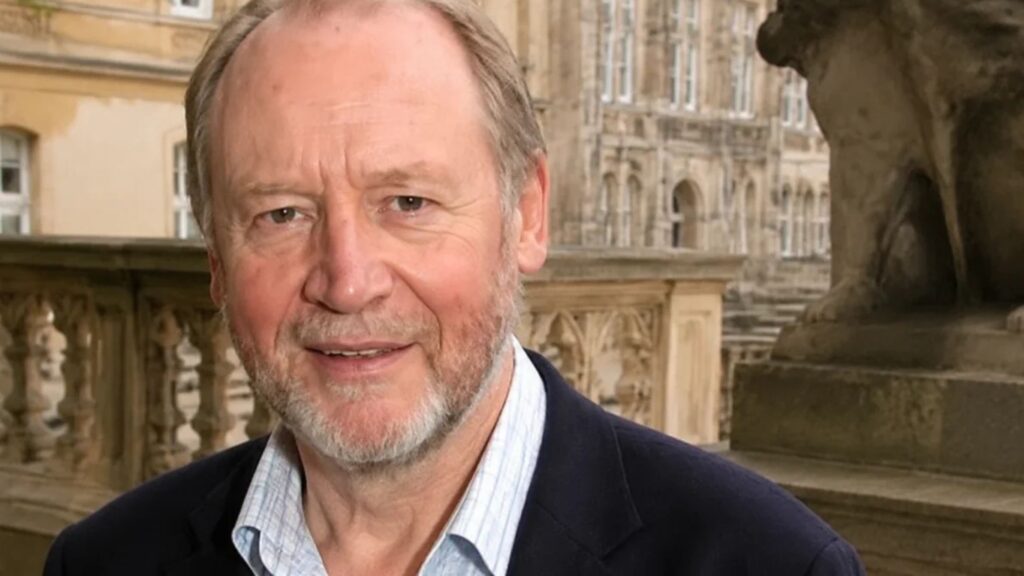
He doesn’t enjoy the global renown of his father, Sir David Attenborough, whose voice is enshrined in documentaries that have influenced the way millions view this globe. Yet Robert Attenborough’s life has its own quietly intriguing story, based on science, on genuine interest and intellectual achievement rather than television cameras. Robert’s story is one of a man who, while his family name travelled across screens and stages around the world, chose the life of scholarship and intellectual curiosity. At 74 years old in 2026, That difference is part of what makes Robert’s life worth knowing for its own sake,
A Private Life of a Scientist
Robert Attenborough, born in August 1951, was raised in a home already attuned to scientific curiosity and education. His father, Sir David Frederick Attenborough, was developing his skills as a broadcaster when Robert was little and his mother, Jane Elizabeth Ebsworth Oriel, was a steady companion in family life until her death in 1997. Robert’s younger sister, Susan, would become a primary school teacher but Robert was interested in the biological sciences.
Son of one of the most recognisable natural history broadcasters of the 20th and 21st centuries, Robert forged his career out of the limelight. David became world famous for his work, but Robert concentrated on the study of human biology and evolution. Based on his birth month and year of August 1951, public data and Robert’s academic profiles show that he will be 74 years old in 2026.
Early life and family
The Attenborough household at the middle of the 20th century was a place of books, curiosity and academic support. Their father was already developing his own scientific interests and broadcasting ambitions, and pushed his children to engage with the world intelligently. So Robert was exposed early, not to television production, but to natural science and anthropology. Education was highly valued in the family and thus predisposed Robert to a lifelong dedication to scholarly endeavours.
His parents married in 1950 and remained married for almost 50 years, until Jane died in 1997. David and Jane brought up Robert and Susan with the same blend of intellectual stimulation and love that had characterised their own relationship. David’s memoirs and interviews over the years reveal his profound love for his children, and at times a mild sadness at missing family moments during long shoots. But these early years, influenced by a family that encouraged curiosity, helped lay the groundwork for Robert’s eventual career in science.
Why I Prefer Academia over Fame
Robert Attenborough, unlike many offspring of famous parents, shied away from public prominence. Instead he sought academic credentials in biological anthropology, a blending of human biology, evolution and population studies. He works in human population biology and health, with a special interest in research on human societies in the Asia-Pacific region, particularly Papua New Guinea.
Robert spent most of his working life at the Australian National University (ANU), in Canberra, where he was a senior lecturer in bioanthropology. There, he was known by students and colleagues as a dedicated teacher and researcher whose courses and guidance moulded generations of biological anthropology students. Alongside his teaching, Robert played a role in the development of curriculum aspects to enhance the prominence of the subject at ANU such as the inclusion of human variation, physiology and behavioural ecology into academic programs.
Although he withdrew from full time duties in 2013 Robert’s academic influence continues through research contributions and collaborations and as Senior Fellow at the McDonald Institute for Archaeological Research at the University of Cambridge. That association with Cambridge hints to a long-standing relationship with serious scholarship, across continents and decades of study.
Research Topic: People and Populations
Robert’s study tends to focus more on issues of human biology, adaption and how populations develop over time. He has written or co-written several book chapters and journal papers, mainly on studies of the genetic history and human demography of New Guinea. His publications on subjects including regional population dynamics, ancient DNA and environmental adaptation situate him in a global context of human evolutionary history.
It is this focus on human populations that separates Robert’s scholarly identity from his father’s popular animal documentaries. David’s voice discussed animal life and planet scale ecosystems to general audiences, whereas Robert’s work looked at the intersection of human biology with environment, culture and evolutionary pressures. Popular scientific communication and academic anthropology are both driven by the same curiosity. They’re just pursued through quite different pathways.
News Headlines Life Outside
With the burden of his father’s renown – not least with Sir David turning 100 in 2026 – Robert has been careful to stay out of the limelight and avoid a public persona. While news outlets are celebrating Sir David’s centenary and looking back at his broadcasting accomplishments, Robert’s name is to be found mostly in academic directories and research profiles, not in tabloids or entertainment sites.
His private life such as his marital status, children or hobbies are not well documented in publically recognised sources. Unlike those of well-known actors or broadcasters, with family ties and personal routines that are frequently chronicled, Robert’s personal routines are not widely chronicled. That preference for privacy fits with his work life, which is based on long hours of research, teaching and collaboration, not public spectacle.
Scientific and Academical Contribution
Scientific and Academic Contribution – robert attenborough age
In academics, it’s length and depth, not sound bites. That ethos is embodied in Robert’s career. He was an educator who taught foundational topics such as human variation and evolutionary views on human behaviour. He helped develop programs that provided students the chance to relate biological data to anthropological insights, a process that usually takes years and is published in peer-reviewed research, not front-page headlines.
His associations with leading research groups such as the ANU and Cambridge are further evidence of the high regard he is held in by his colleagues. He is a Senior Fellow of the McDonald Institute for Archaeological Research where he is surrounded by colleagues studying human evolutionary history from many perspectives, combining archaeological evidence, anthropological theory and biological data.
Robert’s work in Papua New Guinea is still relevant because the people there help us understand patterns of human variety around the world. Robert’s contributions are particularly essential, as scientists typically turn to the genetic, cultural and environmental richness of Papua New Guinea to study how people have adapted to some of the most diverse locations on Earth.
Relationship between Family and Legacy
In family recollections repeated in conversations with Sir David, Robert is singled out with affection. In one echo of the Attenborough love of wildlife, Sir David once gave Robert a salamander for his eighth birthday, just as his father had given him similar wonders as a boy. That story is a portrait of not simply the warmth of family, but the continuous subject of curiosity about life, human or animal.
The Attenborough name is globally significant because to Sir David’s work in wildlife broadcasting and education. But the family’s reach extends into other realms—arts, science, conservation and academia—through cousins who have made their own imprint in their own different domains. Take Robert’s sister Susan, for example, who found her own way to education and community influence.
Robert’s career began in a world not quite as connected by digital media as now, but he forged a life across cultures and continents, from England to Australia and back through academic affiliations with Cambridge. In this respect his work is really global in its intellectual imprimatur, though it has never been broadcast all at once to millions.
What is Robert Attenborough doing now
Robert Attenborough is related to academic research, consultancy and scholarly discussion in 2026. His formal retirement from teaching in the classroom has not meant a complete retreat from his field. His name in the directory of Cambridge’s McDonald Institute implies he remains active in research and mentorship and his work is still cited by fellow anthropologists and institutions.
His father’s projects may still be reaching the masses, but Robert’s impact is measured in academic impact, respect from colleagues and the pupils he helped to shape. That distinction speaks as much to the choices he took as it does to the character of scientific life in the current day.
FAQ’s
What is Robert Attenborough’s age?
Robert Attenborough was born in August 1951 (making him 74 years old in 2026)
Who is Robert Attenborough’s father?
His parents were Jane Elizabeth Ebsworth Oriel and Sir David Frederick Attenborough, the famous broadcaster and natural historian.
What is Robert Attenborough’s profession?
Robert Attenborough is a biological anthropologist and professor. He was a senior lecturer at the Australian National University and is a Senior Fellow at the McDonald Institute for Archaeological Research.
Is Robert Attenborough a celebrity?
He is a known intellectual figure in his field, but not a celebrity. His work life is better chronicled by academic directories than popular media.
Where does Robert Attenborough reside?
He lived for many years in Canberra, Australia, where he worked at ANU, and has links with the University of Cambridge.
Robert has children?
There is no confirmed information from reliable public sources about his children or family life, apart from his own biography and career.
Why is Robert not as famous as his father?
Robert picked academia over public broadcasting, which of course is less noticed by the global media. That’s a choice that comes from personal preference and a concentration professionally on study rather than public performance.
Conclusion
Robert Attenborough’s life is a tribute to quiet intellectual dedication in a family renowned for public communication about wildlife. He will be 74 in 2026, and his work in biological anthropology takes the Attenborough legacy into the study of mankind itself. His academic achievements remind us that influence is not necessarily about celebrity. It is about continuous interest and creation of knowledge over generations. While the world rightly celebrates his father’s century of storytelling, Robert’s contributions are a small but meaningful chapter in a remarkable family story.